Dr. Daipayan Ghosh - Senior Consultant Robotic, Laparoscopic & General Surgeon in Gurugram (Gurgaon)

22+ Years of Surgical Experience | 5,000+ Surgeries | Minimally Invasive & Laser-Assisted Surgery

Minimally Invasive & Surgical Vein Care • Gurgaon


Varicose Veins Treatment in Gurgaon
Endovenous Laser Treatment • Sclerotherapy • Conventional Surgery
Varicose veins do not always require the same treatment. The appropriate approach depends on the pattern of venous reflux, the veins involved, symptoms, disease severity and your individual circumstances.
The goal is not simply to choose the newest procedure. It is to choose the right treatment for the right vein and the right patient.
Patient Decision Guide
Do All Varicose Veins Need Treatment?
No. Not every visible varicose vein requires a procedure.
Some varicose veins may mainly be a cosmetic concern, while others can cause aching, heaviness, swelling, itching or other symptoms. More advanced venous disease may be associated with skin changes, inflammation, bleeding or ulcers.
Treatment is considered after understanding your symptoms, examining the legs and, when appropriate, assessing the veins with duplex ultrasound.
The presence of varicose veins alone does not determine which procedure you need.
Understanding Varicose Veins
What Are Varicose Veins?
Varicose veins are enlarged, twisted superficial veins that commonly develop in the legs when the normal flow of blood back towards the heart is impaired by venous valve dysfunction and reflux.

Common Symptoms
-
Aching or discomfort in the legs
-
Heaviness or tiredness
-
Leg swelling
-
Burning or itching
-
Night-time discomfort or cramps
Visible Changes
-
Bulging veins
-
Twisted or rope-like veins
-
Skin discoloration
-
Venous eczema
-
Skin thickening
-
Fine Reticular Varicosities
More Advanced Disease
-
Recurrent inflammation
-
Bleeding from a varicose vein
-
Skin breakdown
-
Ulcers or Wounds that do not heal
-
Persistent swelling
When Should You Seek Medical Advice?
Don't Ignore Varicose Veins When They Are Causing Problems
Persistent Symptoms
Pain, aching, heaviness, itching or swelling that interferes with daily activities, work or sleep should be evaluated.
Skin Changes
New pigmentation, eczema, skin thickening or other changes around the ankle or lower leg warrant assessment.
Complications
Bleeding, recurrent inflammation, painful thrombosed veins or a non-healing ulcer require medical evaluation.
Diagnosis Before Treatment
The Treatment Starts With Understanding Your Veins
A duplex ultrasound (colour Doppler examination) of the veins of the lower limbs can help identify venous reflux, assess blood flow and determine which veins are involved.

1
Clinical Assessment
Symptoms, clinical examination and a detailed medical history taking in the OPD.
2
Duplex Ultrasound
Assessment of venous flow and reflux. And rule out venous blockage or thrombosis
3
Identify the Source
Understand which veins are contributing to the problem. And which leg needs treatment.
4
Assess Severity
Consider symptoms and skin or other disease changes.
5
Plan Treatment
Select the most appropriate treatment option.
Treatment Options
There Is No Single Best Treatment for Every Varicose Vein
Depending on the venous anatomy and individual circumstances, treatment may involve endovenous laser treatment, sclerotherapy or conventional surgery.

Minimally Invasive
Endovenous Laser Treatment
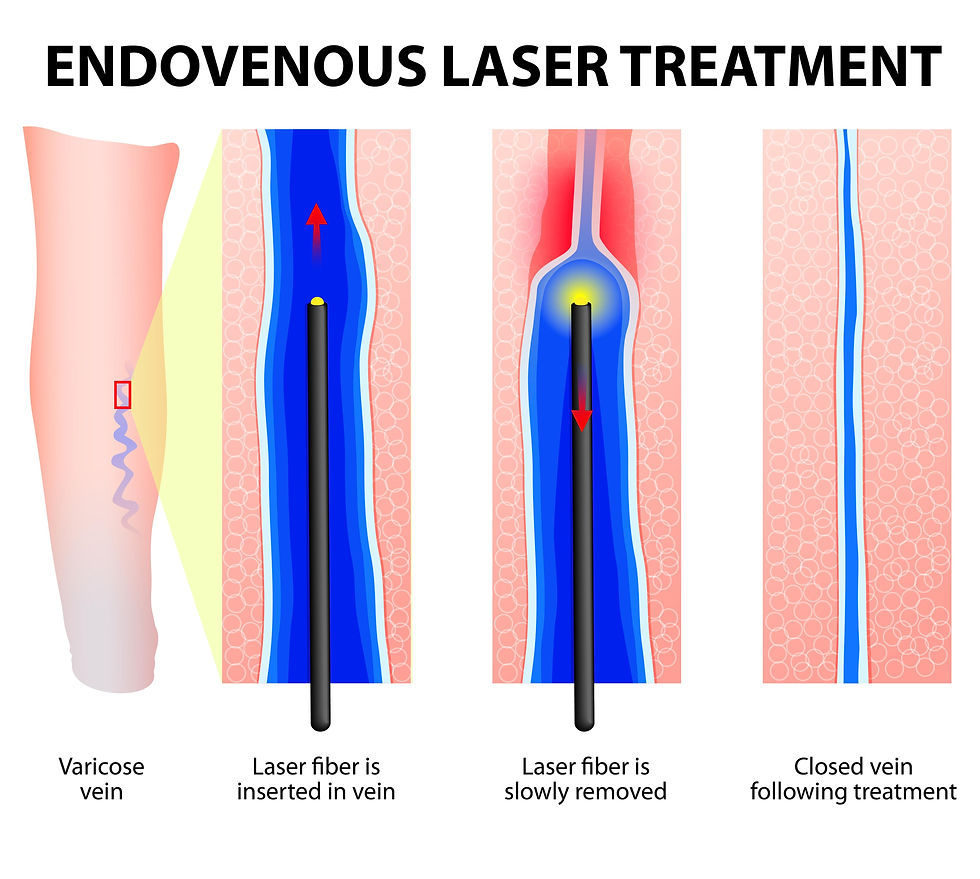
Endovenous laser treatment (EVLT/EVLA) uses a catheter and laser energy to close an incompetent vein from within.
-
Ultrasound-guided treatment
-
Small access point rather than a large incision
-
Used for selected incompetent veins
-
Usually allows relatively rapid mobilisation
-
Suitability depends on venous anatomy
Injection Treatment
Sclerotherapy
Sclerotherapy involves injecting a medicine called a sclerosant into selected veins to cause them to close.
-
Useful for selected veins and tributaries
-
May be performed using ultrasound guidance
-
Foam sclerotherapy may be appropriate in selected cases
-
More than one treatment session may sometimes be required
-
Choice depends on vein characteristics
Conventional Surgery
Open Varicose Vein Surgery
Conventional surgery remains an option in selected patients when the anatomy or clinical situation makes endovenous or injection treatment unsuitable.
-
High ligation in selected cases
-
Vein stripping when appropriate
-
Phlebectomy for selected varicose tributaries
-
Can address specific anatomical patterns
-
Recovery is generally longer although the duration varies according to the procedure and individual patient factors.
Endovenous Laser Treatment
What Is Endovenous Laser Treatment for Varicose Veins?
Endovenous laser treatment, also called endovenous laser ablation (EVLA), is a minimally invasive procedure used to close an incompetent vein responsible for venous reflux.
Under ultrasound guidance, a thin catheter is introduced into the target vein. Laser energy is then delivered through the catheter, causing the treated vein to close.
The circulation does not stop when the treated vein closes. Blood is redirected through other functioning veins.
EVLT is not automatically the right procedure for every patient. The suitability of treatment depends on the anatomy and reflux pattern demonstrated during assessment.
Injection Treatment
Sclerotherapy for Varicose Veins
Sclerotherapy is an injection-based treatment in which a sclerosant is introduced into selected veins. The treated vein subsequently closes and is gradually absorbed by the body.
Which Veins?
Sclerotherapy may be appropriate for selected varicose veins, tributaries and smaller superficial veins.
Ultrasound Guidance
Ultrasound guidance can help identify and treat veins that are not easily visible from the skin surface.
Multiple Sessions
Depending on the extent of disease, more than one treatment session may sometimes be necessary.
Conventional Treatment
When Does Conventional Varicose Vein Surgery Still Have a Role?
Some patients have venous anatomy, disease characteristics or other circumstances where an endovenous procedure or sclerotherapy may not be suitable.
Depending on the individual situation, conventional treatment may involve procedures such as ligation, stripping or phlebectomy.
The objective is not to avoid conventional surgery at all costs. The objective is to select the treatment that offers the most appropriate solution for the individual patient.
Treatment Comparison
Laser vs Sclerotherapy vs Conventional Surgery
Endovenous Laser
Minimally invasive
Yes
Small puncture/access site
Access
Selected incompetent veins
Typical role
Ultrasound guidance
Usually
Recovery
Generally rapid
Number of sessions
Depends on disease
Sclerotherapy
Yes
Injection
Selected veins and tributaries
Often, when appropriate
Generally rapid
May require multiple sessions
Conventional Surgery
No
Surgical incisions
Selected anatomical situations
Usually longer
May assist planning
Usually operative treatment
Best choice
Depends on the patient's venous anatomy, reflux pattern, symptoms and clinical circumstances.
After Treatment
Recovery After Varicose Vein Treatment
Recovery depends on the treatment performed, the extent of disease, associated procedures and individual patient factors.

First Few Hours
Mobilisation
Walking is generally encouraged after appropriate minimally invasive treatment unless your surgeon advises otherwise.
First Few Days
Bruising & Tightness
Mild bruising, tenderness or a pulling/tight sensation along a treated vein can occur.
Activity
Keep Moving
Avoid prolonged immobility. Your surgeon will advise when heavier exercise can be resumed.
Work
Return to Routine
Many patients return to routine activities relatively quickly, although this depends on the procedure and occupation.

Compression Stockings
Do I Need Compression Stockings After Treatment?
Compression stockings may be recommended after some varicose vein procedures, but they are not necessarily required in exactly the same way for every patient.
The need for compression, the level of compression and the duration of use depend on the procedure performed, the extent of treatment and your individual circumstances.
Do not choose compression stockings solely on the basis of advice from friends or online sources. Your surgeon should guide you regarding the appropriate garment and duration.
Postoperative Troubleshooting
After Varicose Vein Treatment: What Is Normal and What Is Not?
Recovery after varicose vein treatment is usually straightforward, but it is important to know what you may experience during the healing period and which symptoms should prompt you to contact your surgeon.
Some discomfort and visible changes in the treated leg are expected after treatment. Mild bruising, for example, is common and usually settles gradually as the tissues heal. You may also notice mild tightness or a pulling sensation along the treated vein. This can occur as the treated vein undergoes the healing process and generally improves with time.
Mild tenderness around the treated area can also occur. This is often related to local inflammation and normal healing. Following your surgeon's postoperative instructions regarding walking, medication, wound care and compression stockings can help support recovery.
Increasing redness or pain, particularly when it is progressively worsening rather than improving, should be discussed with your treating surgeon. It may require examination to determine whether there is significant inflammation, infection or another postoperative problem.
Persistent or increasing swelling deserves attention, especially if the swelling is significant, occurs predominantly in one leg, or continues to worsen rather than gradually improving. In such circumstances, you should contact your surgeon promptly for clinical assessment.
There are also symptoms that require urgent medical attention. Sudden severe swelling or pain in one leg, particularly when associated with chest pain or breathlessness, could indicate a serious complication such as a blood clot and should not be ignored. If you develop chest pain, sudden difficulty breathing, coughing up blood, or severe and rapidly worsening leg symptoms, seek emergency medical care immediately.
When Should You Seek Urgent Medical Attention?
After varicose vein treatment, seek urgent medical attention if you develop:
-
Sudden or marked swelling of one leg
-
Severe or rapidly increasing leg pain
-
Significant bleeding that does not stop with pressure
-
Chest pain
-
Sudden breathlessness
-
Coughing blood
-
High fever with worsening wound redness or discharge
Long-Term Expectations
Can Varicose Veins Come Back After Treatment?
Treatment closes, removes or reduces the veins that have been treated, but it cannot guarantee that new venous disease will never develop.
New varicose veins may appear over time, and some patients may require additional treatment or more than one treatment session.
Successful treatment should therefore be viewed as part of long-term management of venous disease rather than a guarantee that varicose veins can never recur.
Dr. Ghosh's Treatment Philosophy
How do we decide which Treatment Is Right for You?

1
Clinical Assessment
2
Duplex Ultrasound
3
Identify the Reflux
4
Assess Severity
5
Select Treatment
Why Patients Choose Dr. Ghosh
Experience Matters When Choosing a Treatment
22+ Years
More than two decades of surgical experience across a broad range of surgical conditions.
5,000+ Surgeries
Extensive operative experience with a focus on appropriate surgical decision-making.
Individualised Planning
Treatment recommendations are based on the patient's clinical findings and venous anatomy rather than technology alone.
Gurgaon & Gurugram
Varicose Vein Treatment in Gurgaon(Gurugram)
Patients from Gurgaon, Gurugram, Manesar and surrounding Delhi NCR areas can seek evaluation for symptomatic varicose veins, venous reflux, and treatment options including endovenous laser treatment, sclerotherapy, and conventional surgery.
Treatment planning begins with understanding the patient's symptoms and, when appropriate, the underlying venous anatomy using duplex ultrasound.
Not Sure Which Varicose Vein Treatment Is Right for You?
A consultation can help determine whether your varicose veins require treatment and, if they do, whether endovenous laser treatment, sclerotherapy, conventional surgery or another approach is appropriate.